
Which trees end up coming down around North Augusta?
Most removals start with a tree that has given a reason. Clemson Extension's hurricane fact sheet, written after Helene, names water oaks, pecans, Bradford pears, maples and pines among the common yard trees that blew over or broke in that storm (Clemson HGIC 1040, Mar 13, 2026; checked Nov 15, 2026).
- Water oak. Clemson calls it "more weak-wooded than most oaks," prone to wind and ice damage, and notes that its trunk often rots by the time the tree is about 50 years old. It grows 50 to 60 feet tall and about as wide, on shallow, spreading roots (Clemson HGIC 1017, updated Feb 29, 2024; checked Nov 15, 2026).
- Loblolly and longleaf pine. Both are rated medium-low for hurricane resistance (HGIC 1040). A tall pine near a roof gets its own guide: pine trees near houses.
- Pecan. Clemson calls it prone to windthrow during hurricanes, meaning the whole tree tips over at the roots.
- Bradford pear. On the same Helene failure list.
Live oak and southern magnolia sit at the other end of Clemson's scale, rated high for wind resistance, with sweetgum at medium-high. A sound live oak is usually worth keeping and trimming rather than taking down.
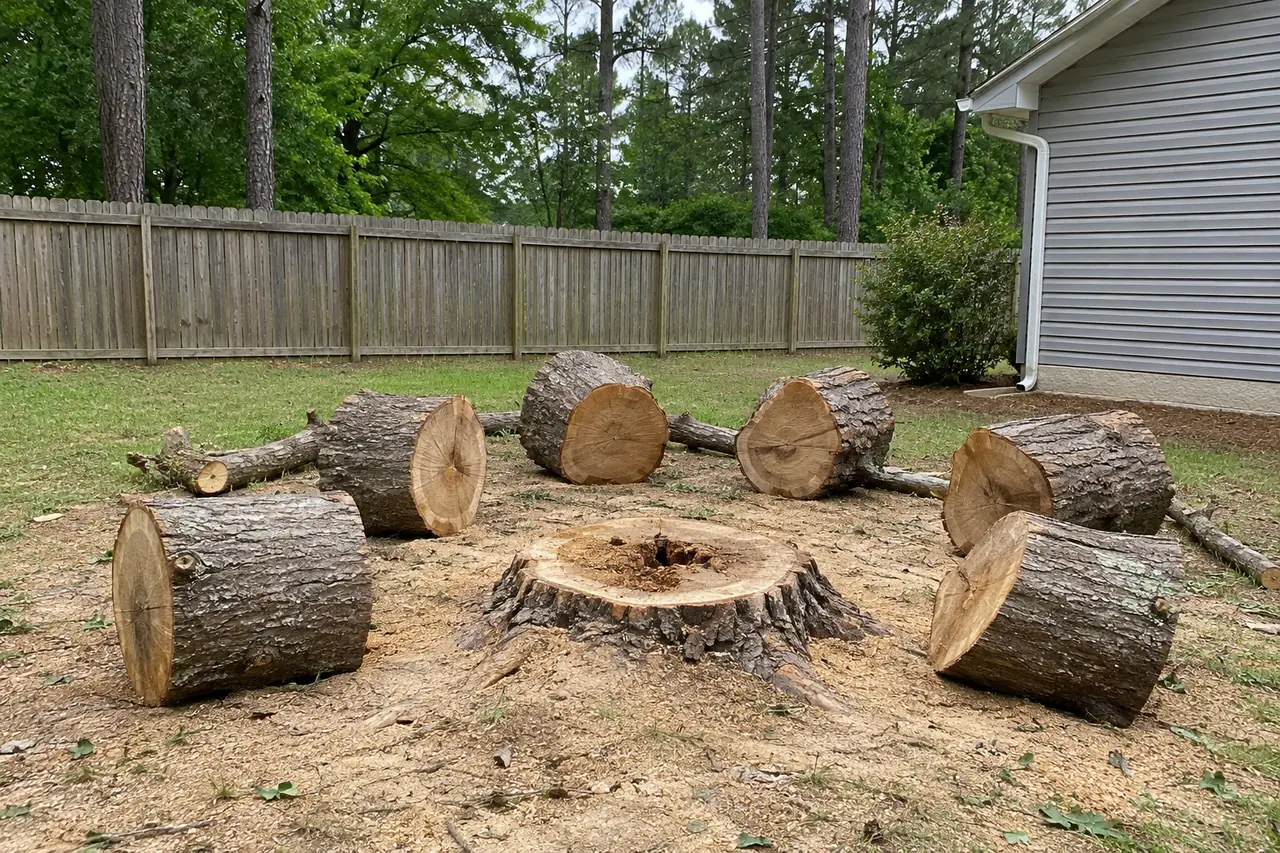
What signs say a tree should come down?
Clemson's quick yard check is a good way to sort a tree that needs to go from one that needs a trim (Clemson HGIC, "A routine check-up of trees saves lives and property," Jun 8, 2021; checked Nov 15, 2026). In plain terms, look for:
- Dead, hanging or broken branches; ones over 2 inches thick can fall.
- A lean, especially a new one with a mound of soil or exposed roots at the base.
- Soil cracking near the base, or broken roots sticking out of the ground.
- Cracks between two trunks of the same size, or where a limb over 3 inches meets the trunk, which Clemson says "indicates a high probability of failure."
- Mushrooms or conks on the trunk or roots, which point to advanced decay.
Clemson suggests running through this list twice a year. If two or three of these show up on any tree tall enough to hit the house, the driveway or a neighbor's roof, that's the tree to have looked at first.
Are oak diseases a reason to remove a tree here?
Sometimes. Oak wilt, a fungal disease that kills oaks, is confirmed in Aiken County. The USDA Forest Service's South Carolina forest health reports list it in the sandbelt counties, Aiken included, in 2024 and again in 2025, and Clemson Extension counts Aiken among nine South Carolina counties where it occurs (USDA Forest Service, SC Forest Health Highlights 2024 and 2025; Clemson HGIC 1017; checked Nov 15, 2026). In news reports from February 2026, the City of Aiken said 22 water oaks on Charleston Street tested positive.
Hypoxylon canker is the other oak problem worth knowing. Clemson lists water, post, southern red, white and blackjack oaks as hosts, with drought the biggest trigger and construction damage to roots and packed soil adding to it. The sign is brownish fungal growth under bark that's peeling away, turning silver-gray and then black, along with dieback in the crown. Clemson says there's no chemical control once the trunk is infected and advises removing infected trees (Clemson HGIC 2006, updated Feb 13, 2026; checked Nov 15, 2026).
A dead or dying oak doesn't get stronger standing. Water oak wood is already weak, and decay makes the timing of the failure harder to guess.
Does the city have to sign off first?
For a tree on an existing single-family lot, the North Augusta Development Code sets no permit (Development Code REV 2-5-2025; checked Nov 15, 2026). The city's tree rules apply to development applications, clearing and grading permits, and street trees. The rule a homeowner is most likely to run into is the street-tree rule: the code expects the owner next to the curb strip to maintain those trees, but says the owner may not remove, prune or thin them without "the written permission of the city." That wording is Sec. 7.10.3 of the Development Code the city adopted on Dec. 18, 2023 (Ord. 2023-32), as posted in its Feb. 2025 revision (checked Nov 15, 2026).
If the tree stands anywhere near the street, call Public Services, which lists Trees & Landscape Maintenance at (803) 441-4240, before work is scheduled. The North Augusta tree rules page goes through the whole code, and the Aiken page covers that city's protected-tree limits, which reach land not zoned single-family.
How does a tall tree come down next to a house?
Rarely in one piece. Where there's open lawn as long as the tree is tall, a crew may drop it whole. Beside a house, a climber usually takes it down in sections, lowering heavy pieces on ropes, or a crane lifts sections over the roof. Cost guides list the crane as an extra; HomeGuide puts it at $500-$2,500 a day (checked Nov 15, 2026). The prices page has the other extras.
What the crew needs from you is simple: a clear path for equipment, the gate width, where the septic tank or drain lines run if you know, and anything under the tree you care about, from a fence to a flower bed.
What if the tree touches a power line?
Then the power company comes first. South Carolina's Office of Regulatory Staff says the utility "should first be contacted before trees are worked on near power lines" (ORS, checked Nov 15, 2026). Dominion Energy South Carolina says only line-clearance workers who meet OSHA's qualification may work within 10 feet of its lines, and that it will disconnect a home's service line, without charging the owner, so the owner or the owner's contractor can take limbs or the tree down safely (Dominion Energy SC tree guidance, checked Nov 15, 2026).
Depending on the address, power in Aiken County comes from Dominion Energy South Carolina or an electric cooperative such as Aiken Electric Cooperative (803-649-6245). Your bill tells you which. Settle with the contractor who makes the call before the job is booked.
Where does all the wood go?
Out with the crew, if you write it into the price. North Augusta's City Code Sec. 14-121(c) says refuse from contractors, landscapers, yard crews and tree trimming or removal companies "shall not be the responsibility of the city"; the company or the owner must remove it (checked Nov 15, 2026).
What the city does take from homeowners has limits. Under Sec. 14-121(b), no single item can be more than 4 feet in diameter, 10 feet long or 200 pounds, and the city may limit how much it picks up. Burning it isn't a simple fallback either: Sec. 11-5 bars outdoor rubbish fires inside the city without a written permit from the public safety director, granted only for special need. If you want the logs for firewood, say so up front and agree on the length they're cut to.
Does the stump come out at the same time?
Only if it's in the agreement. Many removals leave a stump cut close to the ground, with grinding as a separate line. South Carolina treats digging with machinery or deeper than 12 inches as excavation that needs an SC811 notice three to twelve full working days ahead, so a stump ground the same day as the removal needs that notice in already. See stump grinding.
Removal questions from homeowners
Can I take down a tree in my own backyard without asking the city?
On an existing single-family lot in North Augusta, the Development Code sets no permit for it (Development Code REV 2-5-2025; checked Nov 15, 2026). Street trees by the curb are the exception, and land being cleared for development has its own permits.
The tree is in the grass between the sidewalk and the street. What now?
Treat it as a street tree. The code puts upkeep on the property owner next to it but bars removing, pruning or thinning it without the city's written permission. Call (803) 441-4240 first.
Will homeowner's insurance pay to remove a dead tree before it falls?
Don't count on it. South Carolina's Attorney General, citing the Department of Insurance, says policies generally don't cover damage from negligence or poor upkeep, such as a rotten tree (Jan 23, 2026; checked Nov 15, 2026). Check your own policy, and see the storm page for what policies tend to pay after a tree falls.
Is a tree that made it through Helene safe now?
Not necessarily. Clemson points to hidden decay and to two trunks joined with bark pressed between them as weak points that don't show from the lawn. Run the warning-sign list above, and have a closer look taken at anything that reaches the house.
How do I get someone out to look at it?
Call (803) 599-3398 or send the request form. One independent contractor serving North Augusta and Aiken County receives it, inspects the tree, prices it and handles the job if you hire them. The guide to working with a tree company covers what to put in writing.