
How do pines rate against other yard trees in wind?
Clemson's fact sheet on hurricane-resistant landscapes puts familiar Southern yard trees on one scale (HGIC 1040; checked Nov 15, 2026):
| Rating | Trees |
|---|---|
| High | Live oak, southern magnolia |
| Medium-high | Sweetgum |
| Medium-low | Loblolly pine, longleaf pine |
| Failed in Helene (windthrow or breakage) | Water oak, pecan, Bradford pear, maple, pine |
A pine isn't the weakest tree in the yard by default. Clemson calls water oak "more weak-wooded than most oaks," with trunks that often rot by about age 50 (HGIC 1017). What sets a pine near a house apart is height: the taller the tree, the farther away it can reach the roof.
Why do pines go over in soaked ground?
Because roots hold less in wet soil. Clemson notes that soil saturated by rain lets wind uproot even trees with good root systems (HGIC 1040). Clemson's list of Helene failures includes windthrow, meaning whole trees tipped over at the roots, as well as trees that broke.
South Carolina's soils change at the fall line. The South Carolina Encyclopedia describes the Sandhills along the fall line as dry, sandy and low in organic matter, with the Piedmont's soils to the west and Coastal Plain sands and clays beside them, and the USDA's Carolina and Georgia Sand Hills region draws on an Aiken weather station for its climate data (checked Nov 15, 2026). Those sources describe regions, not single neighborhoods, and we didn't read a soil map for any one street (South Carolina Encyclopedia, "Soils"; checked Nov 15, 2026), so look at your own: where water stands after a hard rain, or the ground near a pine stays soft, take note of it.
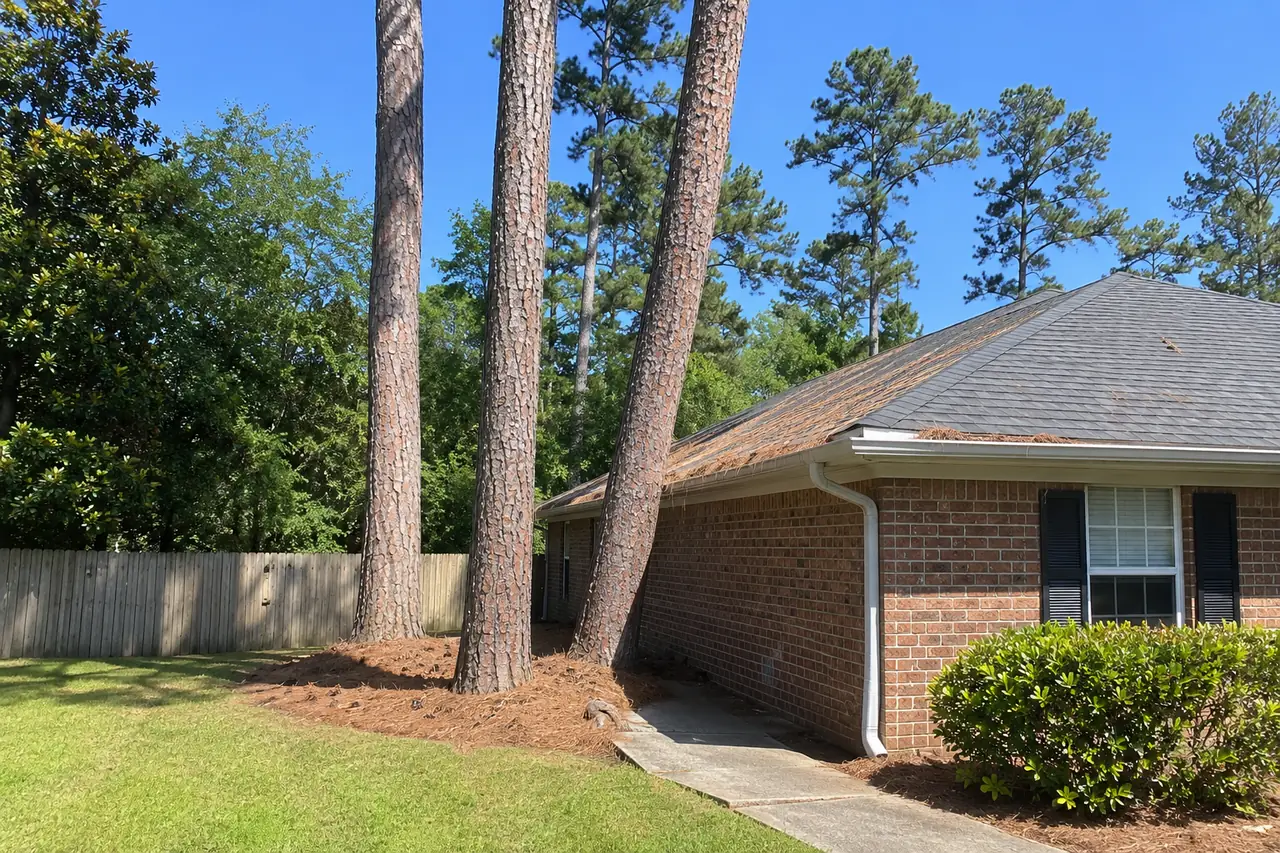
What should I look for at the base of a pine?
Most of a pine's warning signs show near the ground. Clemson Extension's yard check (HGIC, Jun 8, 2021; checked Nov 15, 2026), applied to a pine:
- Soil mound or cracking. Clemson says to look for a mound of soil or cracked soil near the root collar, or broken roots poking out of the ground. On a pine, a raised hump on one side of the trunk can mean the roots are starting to lift.
- A new lean. A pine that has always grown at a slight angle is different from one that started leaning after a storm, especially toward the house.
- Dead, hanging or broken limbs. Branches over 2 inches thick can fall. On a tall pine, they fall a long way.
- Mushrooms or conks. Clemson says these indicate advanced decay.
- Cracks in the trunk, or where a limb more than 3 inches thick joins it.
- A topped crown. Topped trees are more at risk in storms.
Clemson suggests doing this check twice a year, and after any big storm is a good time for one of them.
Are pine beetles killing trees in Aiken County?
Not in an outbreak, as of the latest state reports. The USDA Forest Service's South Carolina forest health report for 2025 says spring trapping found southern pine beetle populations in Edgefield, McCormick, Pickens and Oconee counties, and that no outbreaks were detected that year. In 2024, trapping found the beetle in Edgefield and five other counties, with outbreaks only in McCormick (under 10 acres) and Pickens and Oconee (about 1,000 acres). Neither report records a southern pine beetle outbreak in Aiken County in 2024 or 2025 (SC Forest Health Highlights 2024 and 2025; checked Nov 15, 2026).
We haven't found South Carolina Forestry Commission guidance on beetle signs for homeowners to cite here. If a pine near the house is browning or dropping needles out of season, have it looked at rather than waiting to see what happens.
When does taking the pine down make sense?
Weigh four things: the tree's condition, its height against its distance from the house, what's under it, and how much you value it. A pine is a strong candidate for removal when:
- one or more of the warning signs above show up;
- it's tall enough to reach the house, a bedroom in particular, if it went over;
- it's dead or mostly brown;
- it was damaged in a storm and now has a split, a lean or a broken top.
A healthy, upright pine with sound roots and room around it can stay. If you do replace one, Clemson rates live oak and southern magnolia high for wind resistance, and both are on North Augusta's approved planting list. Dominion Energy South Carolina says trees taller than about 15 feet don't belong under distribution lines.
Do I need permission to take a pine down?
On an existing single-family lot in North Augusta, the Development Code sets no city permit for it (Development Code REV 2-5-2025; checked Nov 15, 2026); the street-tree rule applies only to trees in the strip between the curb and the property line (North Augusta tree rules). In Aiken, the city's Significant and Grand tree limits apply to land not zoned single-family (Aiken Zoning Ordinance §4.6.3; checked Nov 15, 2026), and Aiken County's tree article doesn't apply to individual single- or two-family lots. On qualifying timberland, state law keeps local governments from regulating forestry (S.C. Code § 48-23-205; checked Nov 15, 2026).
What does removing a tall pine cost?
LawnStarter averages pine removal at $925 (updated Oct 5, 2026). HomeGuide lists trees 60 to 80 feet at $650 to $2,000 and those over 80 feet at $1,200 to $2,700, with a crane adding $500 to $2,500 per day (all checked Nov 15, 2026). A pine standing a few feet from the house usually comes down in pieces, which takes longer than felling one into an open yard.
The wood is the other part of the bill. Long pine logs don't fit North Augusta's curbside limits of 10 feet long and 4 feet across, and a tree company's debris isn't the city's to collect (City Code Sec. 14-121; checked Nov 15, 2026). See tree removal prices for hauling figures.
What people ask about their pines
Can a healthy pine stay right next to the house?
It can, if it's upright, the base is firm with no lifted soil, and the crown is green and full. Check it twice a year and after storms, and keep dead limbs off it.
Is a longleaf any safer than a loblolly?
Clemson rates both medium-low for hurricane resistance, so neither gets a pass on rating alone.
The pine survived Helene. Does that mean it's sound?
Not by itself. Clemson notes hidden decay and weak unions often don't show from the ground. Look at the base for the signs above.
Who can come look at a pine by my house?
Call (803) 599-3398 or send the request form. The one independent contractor who gets it works around North Augusta and Aiken County. For a pine that's already fallen, see storm damage; for the stump afterward, see stump grinding.