
Does Aiken's tree ordinance cover my house lot?
Aiken's tree rules sit in Section 4.6 of its zoning ordinance, and they reach all land inside the city limits (§4.6.2). The part that limits removing trees from land that isn't being developed, §4.6.3, applies to land zoned for uses other than single-family residential; Planned Residential land with an approved single-family concept plan is left out too. A second rule, §4.6.6, protects trees after a certificate of occupancy on commercial and multifamily projects, and in the common areas of attached single-family and duplex projects.
So for a detached house on a lot zoned single-family, the removal limits don't apply. For a townhome community's shared grounds, a church, a business or an apartment property, they can.
The current text of §4.6.3 on the city's code host keeps land zoned single-family outside the Significant and Grand tree removal limits, as the 1999 ordinance revised in June 2009 did (Aiken Zoning Ordinance, Chapter 4, Article 6, on Municode; checked Nov 15, 2026). The definitions and penalties below come from the Zoneomics copy, amended to Nov. 12, 2018. Your lot's zoning decides which rule applies, and the Planning Department, 111 Chesterfield St. S, 803-642-7608, can tell you what it is.
What makes a tree "Significant" or "Grand" in Aiken?
Trunk size, measured as diameter at breast height (DBH), 4.5 feet above the ground (Aiken zoning ordinance, Ch. 10, §10.1.2; checked Nov 15, 2026):
| Class | Large-growing tree | Small-growing tree |
|---|---|---|
| Significant | 8 to 24 inches DBH | 4 to 8 inches DBH |
| Grand | 24 inches DBH or more | 8 inches DBH or more |
The City Horticulturist may also name any tree a Grand Tree. North Augusta's code has nothing like it for home lots: it defines "specimen" and "protected" trees by size, but uses those terms only in development plans and sets no permit to remove one from an existing house lot (North Augusta Development Code REV 2-5-2025; checked Nov 15, 2026).
When can a protected tree come down on land the rule covers?
On covered land, the current §4.6.3 says no Significant or Grand Tree may be removed unless the Planning Director, after consulting city staff including the City Horticulturist, is satisfied that one of these is true (all seven are in the current text, as amended by Ord. No. 12142015C of Dec. 14, 2015):
- it's part of good forestry management;
- it's diseased, dying or dead;
- it's a safety hazard to buildings or traffic;
- it's a pine, pecan or magnolia whose debris or sap is affecting vehicles in a parking lot (with replacement);
- it's causing structural damage;
- it interferes with underground utilities;
- it blocks essential road access (with replacement).
"Removal" in Aiken's code is broader than cutting. It includes "any intentional or negligent act that will cause a tree to decline and die" within a year, such as damaging roots, changing the grade around a tree, or pruning it badly. Removing a protected tree without one of the reasons above can bar rezoning the land to commercial or multifamily for two years (§4.6.3.B).
The penalties are real. A violation is a misdemeanor punishable by a fine "not exceeding $500.00," up to 30 days, or both, and each tree counts as a separate offense. The owner can also be required to replant from the city's Approved Tree List, at least 2-inch caliper, matching the total caliper removed, or pay into the city's Tree Fund instead (Ch. 9, §9.1.2-9.1.3; checked Nov 15, 2026). The 2009 text caps a Tree Fund payment in lieu at $500 per acre of the site (§4.6.4.B.2.d).
Is oak wilt killing trees in Aiken?
Oak wilt, a fungal disease that kills oaks, is confirmed in Aiken County. The USDA Forest Service's South Carolina forest health report for 2024 lists it in the state's sandbelt counties, "including Aiken, Barnwell, Lexington, Kershaw, and Florence," and the 2025 report says it continued to be reported there. Clemson Extension counts Aiken among nine South Carolina counties where it occurs (USDA Forest Service; Clemson HGIC 1017; checked Nov 15, 2026).
It has reached the city's own streets. In February 2026, news reports said 22 trees on Charleston Street, all water oaks, had tested positive, and quoted the city's Aaron Campbell saying the trees had been showing the signs and symptoms of oak wilt. A $1 million gift from Robert Johnston, a founder of Aiken Streetscapes, made through the Community Foundation's Aiken Streetscapes Fund, is to pay for removing sick trees and replanting. Homeowners who notice leaves changing color quickly, branches wilting or leaves dropping early were told to contact Clemson Extension (news: Kicks99, Feb. 6, 2026, citing WRDW; checked Nov 15, 2026).
Water oaks were already a weak point. Clemson calls the species "more weak-wooded than most oaks" and says its trunks often rot by about age 50 (HGIC 1017). A water oak that's both old and wilting near a house is a tree to have looked at soon.
What about the big live oaks along Aiken's avenues?
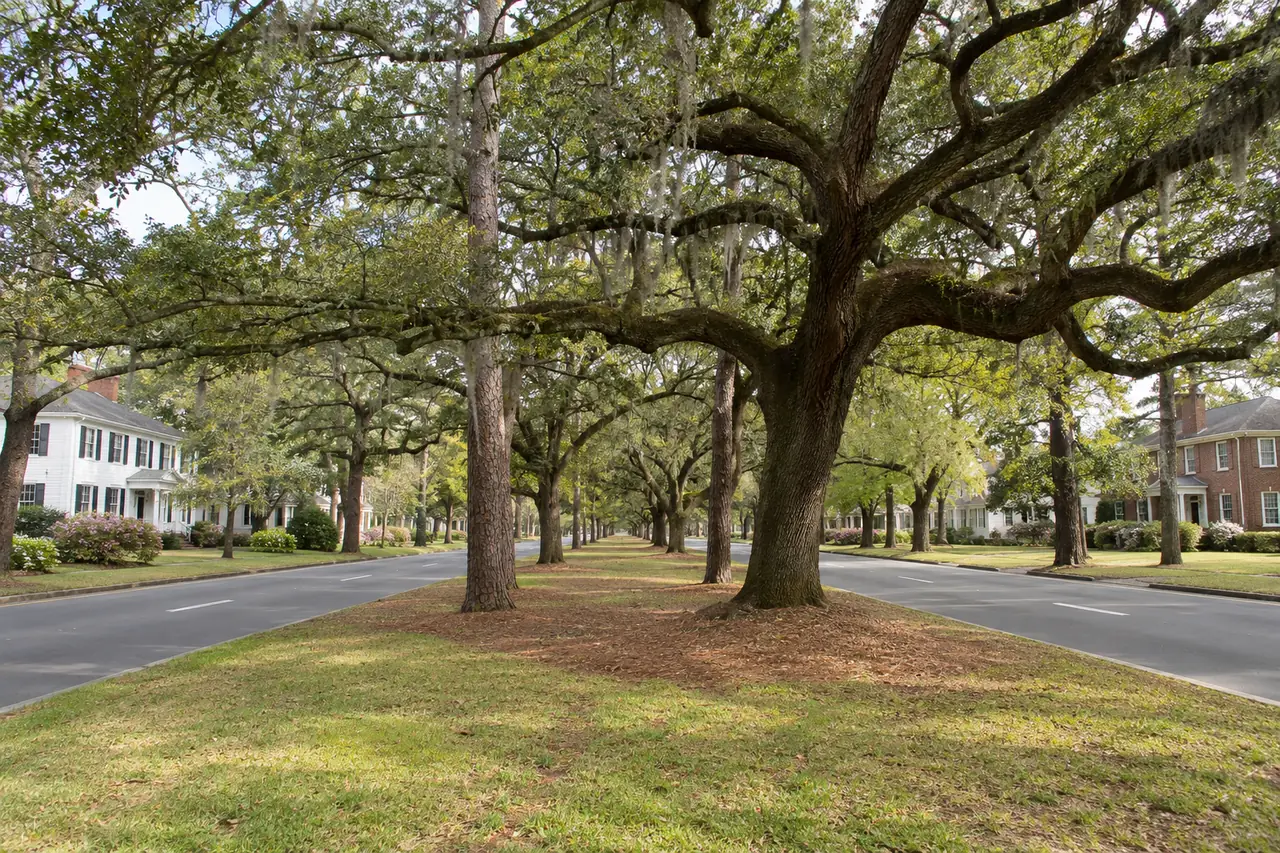
The city, working with the Aiken Streetscapes Foundation, pruned the live oaks along South Boundary Avenue from November through February, from Williamsburg Street west toward Whiskey Road, to lighten the ends of the branches and reduce the risk of limbs failing (City of Aiken; checked Nov 15, 2026). Aiken Regional Medical Centers' page on the avenue describes its "breath-taking aisle of live oaks" and says the Town Council authorized about 500 hardwood trees for the city's streets and avenues between 1877 and 1900 (hospital web page, not an official history).
Clemson rates live oak high for wind resistance. Lightening long, heavy limb ends is the same idea at home when a live oak's limbs stretch over a roof; see tree trimming.
Trees in the street right-of-way have their own rule in the City Code: no tree in a public street, alley, way or place may be cut, destroyed or trimmed by anyone without prior notice to and approval by the city horticulturist (Aiken Code Sec. 36-10(c); checked Nov 15, 2026). Parks and parkways are off-limits for yard trash piles, too (Sec. 32-3(4)). Before anyone touches a tree on a parkway or in the strip by the street, ask the city's Planning Department at 803-642-7608.
How have storms hit Aiken?
Helene's toll in Aiken County was heavy. The National Weather Service in Columbia estimated gusts of 80 to 100 mph across the county and counted 11 deaths, 35 homes destroyed, 1,288 damaged, and "many structures damaged by falling trees." Aiken Municipal Airport's pressure fell to 989.8 millibars. Dominion Energy South Carolina named Aiken Estates among the neighborhoods needing extended repair work because the damage was so severe (NWS Columbia; Dominion Energy SC, Oct. 4, 2024; checked Nov 15, 2026).
Aiken's Hitchcock Woods covers 2,100 acres, "about 2 ½ times the size of Central Park," and is managed with prescribed fire and thinning to restore a longleaf pine and wiregrass forest (Hitchcock Woods Foundation; checked Nov 15, 2026). The Foundation said much of the Woods' 71 miles of trails was significantly damaged by the 2024 hurricane, and reopened the Woods to visitors on Dec. 21, 2024 (Hitchcock Woods Foundation, Dec. 20, 2024; checked Nov 16, 2026). A Jan. 15, 2025 blog post by The Willcox, a local hotel and not an official source, described hundreds and possibly thousands of trees down in the Woods after Helene, and said Helene uprooted whole trees in soaked ground where the 2014 ice storm had mostly broken limbs.
- Feb. 10-14, 2014 ice storm: FEMA disaster DR-4166; FEMA's assessment put Aiken County's public damage at $35.61 per resident against an indicator of $3.50.
- April 5, 2022: an EF2 tornado with 130 mph winds crossed northern Aiken County near Monetta into Lexington County (NWS Columbia, preliminary).
- Oct. 10, 2026: an EF-1 with 105 mph winds snapped trees on a 3.22-mile path near Wagener (NWS Columbia preliminary survey).
The storm damage page covers first steps and insurance when a tree comes down.
How should limbs be set out for pickup in Aiken?
Aiken's Public Services rules for yard trash, from the city's leaf-season notices (City of Aiken, Nov. 2, 2023 and Feb. 13, 2024; checked Nov 15, 2026):
| City of Aiken | North Augusta | |
|---|---|---|
| Length | Limbs cut to six feet or less | No item over 10 feet long or 4 feet in diameter |
| Pile | One pile per property, no longer than 12 feet | Neat, separate piles behind the curb |
| Where not to pile | Under utility lines or limbs with less than 20 feet of clearance; within 3 feet of a water meter, hydrant or other obstacle | Not in the gutter, street or storm drains; 3 feet from obstructions |
| Tree company debris | Owner or tenant must make sure a contractor's debris is removed (Sec. 32-3(13); checked Nov 15, 2026) | Not the city's to collect (Sec. 14-121(c)) |
| Phone | Public Services, 803-642-7613 (Mon-Fri 8:10 a.m.-5:00 p.m.) | Public Services, (803) 441-4240 |
The city's yard-trash notices (leaf season, November 2, 2023; end of leaf season, February 13, 2024; checked Nov 15, 2026) define yard trash as vegetative material from residential property. The City Code puts the contractor question on the owner: owners and tenants "must ensure that debris left by any contractor is removed and properly disposed," and prohibited material mixed into a curb pile is billed at double the special collection fee (Aiken Code Sec. 32-3(13)-(14), as amended Feb. 10, 2020; checked Nov 15, 2026). So put hauling in the written price, or ask Public Services at 803-642-7613.
Can I burn limbs in Aiken?
Aiken's City Code has no open-burning section of its own; searched for "burning," it turns up only smoking and drug-paraphernalia definitions. Instead, § 10-2 adopts the International Fire Code, 2021 Edition, with South Carolina's modifications, so burning inside the city falls under that fire code and the state's open-burning rule (Aiken Code of Ordinances, § 10-2; checked Nov 15, 2026). The state's Forestry Commission notice law doesn't apply inside any city's limits (S.C. Code § 48-35-30; checked Nov 15, 2026), so before lighting anything inside the city, check with the Aiken Department of Public Safety, which provides the city's fire protection. Outside the city, the state notice and burning rules on the Aiken County page apply.
Who handles the lines in Aiken?
Dominion Energy South Carolina serves Aiken County, and so does Aiken Electric Cooperative, headquartered at 2790 Wagener Road in Aiken (803-649-6245; outages: call or text OUT to 877-264-5368). Mid-Carolina Electric Cooperative also lists Aiken County. Which one serves a particular street is on your power bill. South Carolina's Office of Regulatory Staff says to contact the utility before anyone works on trees near power lines (checked Nov 15, 2026).
Aiken situations, briefly
Do I need the City Horticulturist's OK to take down a big oak in my backyard?
If the lot is zoned single-family, the §4.6.3 removal limits we read don't apply to it. Confirm the zoning with Planning at 803-642-7608 if you're unsure.
I live in a townhome community. Does the rule reach our trees?
It can. §4.6.6 protects Significant and Grand Trees in the common areas of attached single-family and duplex projects after the certificate of occupancy, unless one of the listed reasons applies. Talk to the association before any shared tree is cut.
Who do I tell if an oak starts wilting fast?
The City of Aiken pointed homeowners to Clemson Extension, according to the February 2026 news reports. Hold off on pruning it until someone has looked at it.
Can a dead tree come down on a commercial lot?
Under §4.6.3, a diseased, dying or dead tree is one of the listed reasons a protected tree may be removed on covered land; it's shown to the City Horticulturist.
Does the contractor work in Aiken?
Yes. Call (803) 599-3398 or send the request form, and it reaches the one independent contractor this site works with, who covers Aiken as well as North Augusta. For costs, see tree removal prices; for what to put in writing, see working with a tree company.