
What did Helene do in Aiken and Edgefield counties?
The weather service's county impact report for Helene, updated Oct. 31, 2024, gives these figures for Aiken County and its neighbor, Edgefield County (NWS Columbia; checked Nov 15, 2026):
| Aiken County | Edgefield County | |
|---|---|---|
| Estimated top gusts | 80 to 100 mph | 90 to 100 mph |
| Homes destroyed | 35 | 11 |
| Homes damaged | 1,288 | 229 |
| Deaths | 11 | 0 |
| Trees and lines | Widespread trees and power lines down; many structures hit by falling trees; large sections without power; many roads closed, some for an extended time | Widespread trees and power lines down |
The Columbia office's event summary lists a measured gust of 71 knots, about 82 mph, at Bush Field in Augusta, across the river, with sustained winds of 45 knots. The report adds that its point readings likely missed the storm's peak values. Aiken Municipal Airport's pressure dropped to 989.8 millibars (NWS Columbia event summary; checked Nov 15, 2026).
- Federal disaster. The President declared FEMA disaster DR-4829-SC on Sept. 29, 2024, for an incident period that began Sept. 25, 2024. Aiken County was in the first declaration for individual and public assistance; Edgefield County was added later, and FEMA now lists both (FEMA; Federal Register; checked Nov 15, 2026).
- Power. Dominion Energy South Carolina said "thousands of toppled trees decimated" its grid, that more than 90% of its western-region customers lost power, and that neighborhoods including Hammond Hills and Aiken Estates needed extended work because the damage was so severe (Dominion Energy SC, Oct. 4, 2024).
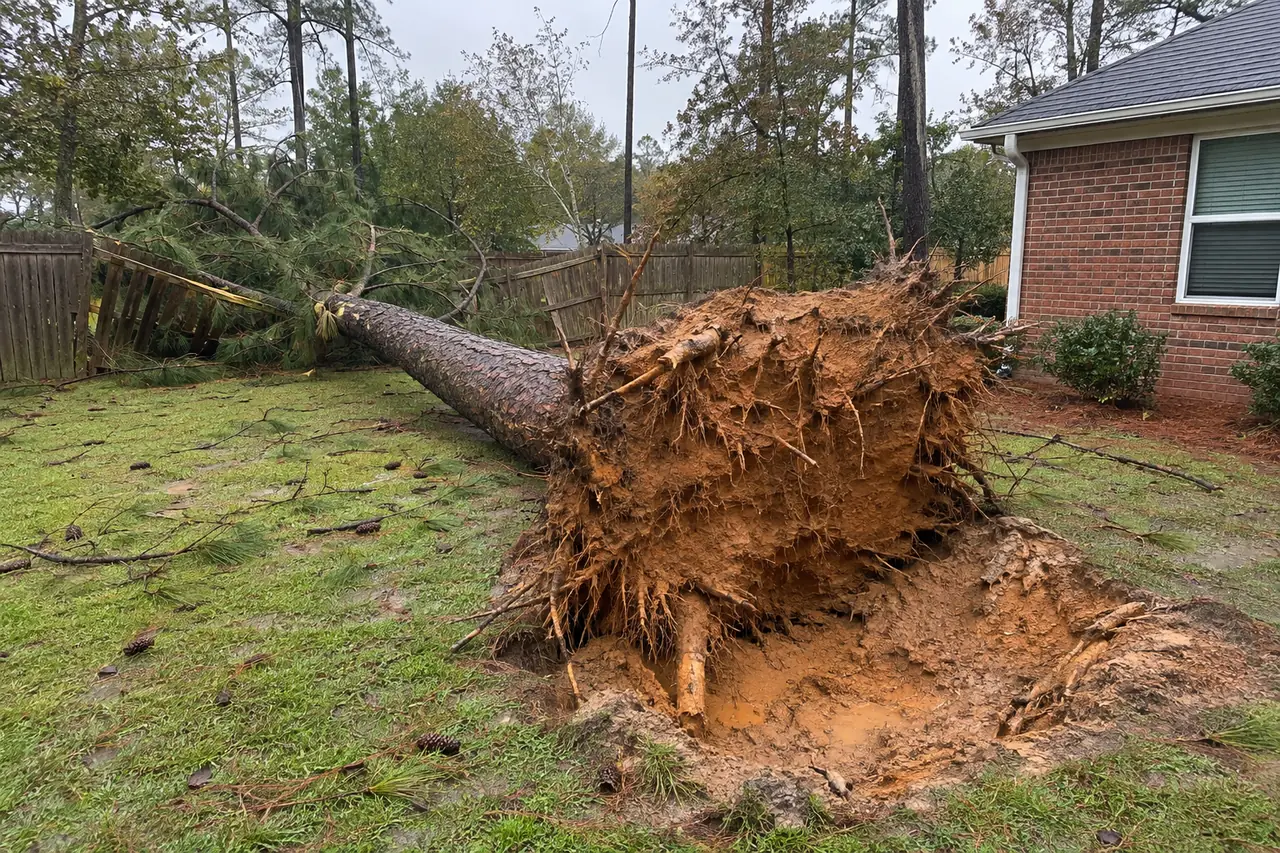
- Trees. The S.C. Forestry Commission's preliminary assessment put Helene's total at $194 million, with $83 million in timber damage across 20 counties and about $60 million in urban forest damage, a figure that doesn't include replacing trees lost in cities and towns. By value, the heaviest timber losses were in Edgefield, Spartanburg, Pickens, McCormick and Aiken counties (SCFC, Nov. 1, 2024; checked Nov 15, 2026).
Which trees failed, and why?
Clemson Extension's fact sheet on hurricane-resistant landscapes, written after Helene, lists water oak, pecan, Bradford pear, maple and pine as trees that blew over or broke in that storm (Clemson HGIC 1040, Mar 13, 2026; checked Nov 15, 2026). It makes three points worth knowing before the next one:
- Soil soaked by rain lets wind tip over even trees with good roots.
- Hidden decay, and two trunks joined with bark pressed between them, are weak points that don't show from the yard.
- Live oak and southern magnolia rate high for wind resistance; loblolly and longleaf pine rate medium-low.
For tall pines close to the house, see pine trees near houses.
What happened in the 2014 ice storm?
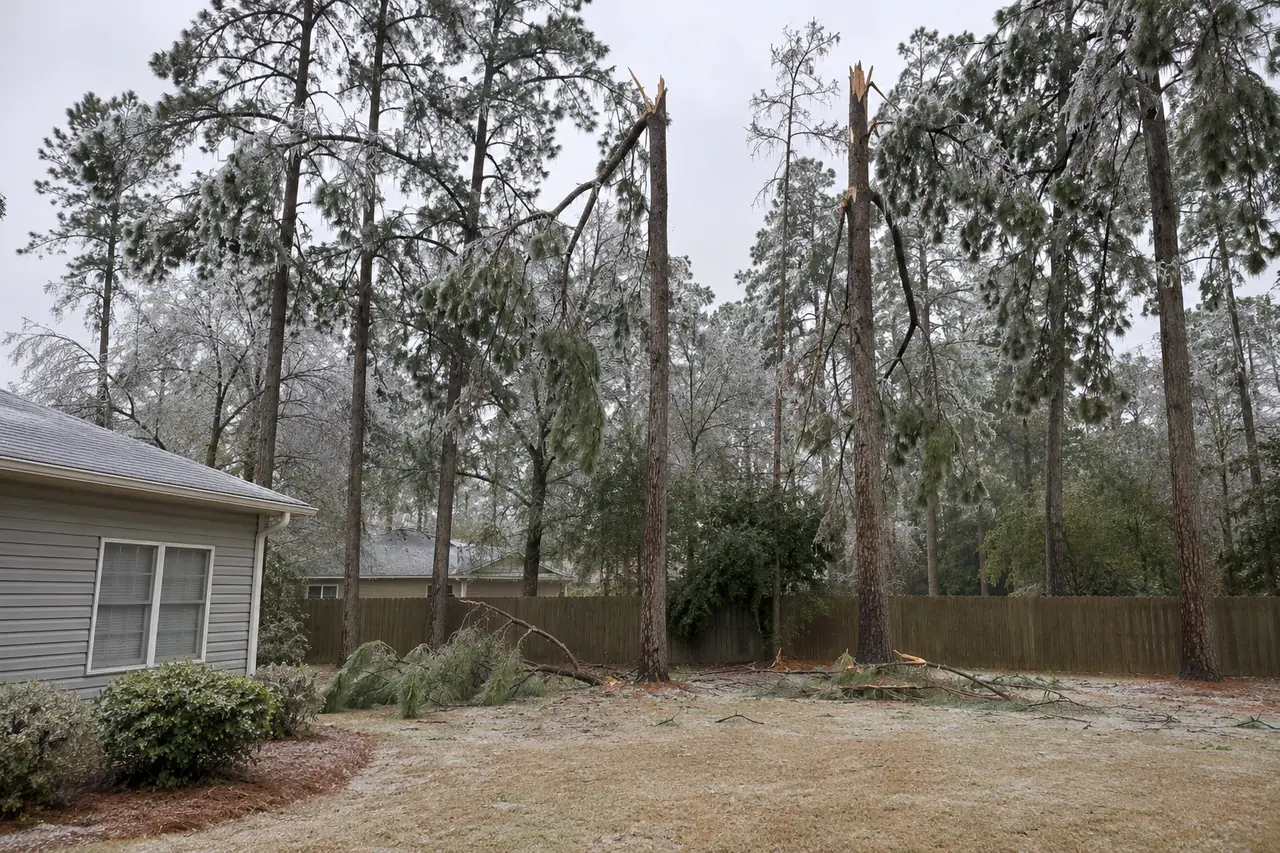
The severe winter storm of Feb. 10-14, 2014 became FEMA disaster DR-4166, declared March 12, 2014, with public assistance for 21 South Carolina counties, Aiken and Edgefield among them. FEMA's damage assessment named "Damage to utilities" as the primary impact and put the statewide public assistance figure at $55,549,089. Measured per resident, the damage came to $35.61 in Aiken County and $36.30 in Edgefield County, against FEMA's indicator of $3.50 (White House release; FEMA damage assessment; checked Nov 15, 2026).
The S.C. State Climatology Office's report on the Feb. 12-13 ice lists 1.2 inches of freezing rain and ice at Aiken and half an inch at Edgefield, and says 346,000 homes in the state lost power. It also cites the Forestry Commission's estimate of $360 million in timber damage across more than 1.5 million acres (SC State Climatology Office, Mar. 25, 2014; checked Nov 15, 2026).
Have tornadoes hit Aiken County too?
Yes. Two of the weather service's recent surveys there:
- April 5, 2022: an EF2 with 130 mph winds tracked 5.7 miles from about 7 miles east-southeast of Monetta into Lexington County, uprooting and snapping trees along Holder Road, Fishhook Lane and westbound I-20, damaging three homes and injuring one person (NWS Columbia, preliminary; checked Nov 15, 2026).
- Oct. 10, 2026: an EF-1 with 105 mph winds ran 3.22 miles southwest and west of Wagener. The damage was mostly to trees, worst along Coleman Bridge Road and Quail Run Road, with no home damage reported (NWS Columbia preliminary survey, issued Oct. 13, 2026; checked Nov 15, 2026).
What should I do first when a tree is on the house?
- Get everyone out of the damaged rooms and away from any tree touching a wire. If someone is injured, or a downed line is sparking, dial 911.
- Call the power company if lines are involved. Aiken Electric Cooperative members can call or text OUT to 877-264-5368; Dominion Energy South Carolina customers use Dominion's outage line on their bill.
- Photograph the tree, the damage and the roof from every side you can reach safely, and keep every invoice. The Attorney General's storm tips say the same (SC Attorney General, Jan. 23, 2026; checked Nov 15, 2026).
- Call your insurer "as soon as possible after the loss," in the Attorney General's words.
- Cover openings only if you can do it safely from the ground.
- Get the removal in writing: scope of work, cleanup and the final cost. Don't sign anything that assigns your insurance benefits to the contractor.
To have the tree looked at, call (803) 599-3398 or send the request form. Either one reaches a single independent contractor working in North Augusta and Aiken County.
What will homeowner's insurance pay for a fallen tree?
Less than many people expect. South Carolina's Attorney General, citing the Department of Insurance, gives an example of a policy paying "up to $1000 in reasonable expenses" for removing a fallen tree, and says that if a tree doesn't touch or damage a covered structure, the policy may pay only if the tree becomes an obstacle. Damage from negligence or poor upkeep, a rotten tree for example, generally isn't covered (Jan. 23, 2026; checked Nov 15, 2026).
Read your own policy's tree and debris wording, and call the Department of Insurance's Office of Consumer Services at 803-737-6180 with questions it doesn't answer.
How do I spot a storm chaser?
The Attorney General's list of red flags after a storm (Jan. 23, 2026):
- Crews that travel in from out of state following storms.
- Unsolicited door-to-door offers, especially with a demand for a cash deposit.
- A promise to cover your deductible.
- Pressure to decide on the spot.
- Being asked to sign on a tablet or phone without reading the terms.
The S.C. Department of Consumer Affairs adds that fraudsters "often use high pressure tactics or create a sense of urgency," and warns against contractors who take only cash (checked Nov 15, 2026). Report problems to the department at (800) 922-1594. During a declared state of emergency, South Carolina's price-gouging law, S.C. Code § 39-5-145, bars "an unconscionable price" measured against the 30 days before the declaration, with a willful violation a misdemeanor carrying a fine of up to $1,000 or up to 30 days (checked Nov 15, 2026). The law's definition of a commodity includes services as well as goods, so it reaches tree work (S.C. Code § 39-5-145(A)(2); checked Nov 15, 2026). The Attorney General's office takes price-gouging reports at 803-737-3953 (SC Attorney General; checked Nov 15, 2026).
Where does storm debris go?
Mostly, it's yours. Dominion Energy South Carolina says "Tree debris resulting from storms is the responsibility of the property owner," and that larger limbs and trunks from its own tree work stay on the owner's land (checked Nov 15, 2026). Inside North Augusta, the city doesn't collect what a tree company leaves (City Code Sec. 14-121(c)), and a homeowner's yard waste goes behind the curb in neat piles with no piece over 10 feet long or 4 feet across.
Don't burn it in town. City Code Sec. 11-5 requires a written permit from the public safety director for any outdoor rubbish fire (checked Nov 15, 2026), and after Helene, North Augusta Public Safety urged residents not to burn storm debris and said the burn ordinance still applied (news: WRDW, Oct. 17, 2024). Outside city limits, the S.C. Forestry Commission notice rules apply; see the Aiken County page.
After-the-storm questions
A neighbor's tree fell on my fence. Who pays?
Start with your own insurer, since policies differ on fences and other structures. On fault, South Carolina's Court of Appeals has said a landowner has a duty to prevent "an unreasonable risk of harm from defective or unsound trees," but declined to extend that duty to trees of natural origin on rural, undeveloped land (Ford v. S.C. Dept. of Transportation, 1997, citing a 1987 decision; checked Nov 15, 2026). So the tree's condition before it fell matters: photograph the trunk, roots and break before cleanup.
Why did the power company leave the wood in my yard?
Because its job is the line. Dominion says larger limbs and trunks stay on the owner's land after its work, and storm debris is the owner's to clear.
Are pines more likely to go over than oaks?
It depends on the oak. Clemson rates loblolly and longleaf pine medium-low for wind, live oak high, and lists water oak among Helene's failures alongside pine.
The tree survived the storm but looks damaged. Can it wait?
A split trunk, a new lean with lifted soil, or a hanging limb over the house shouldn't wait. Clemson's warning signs are on the removal page, and the guide to working with a tree company covers the paperwork.